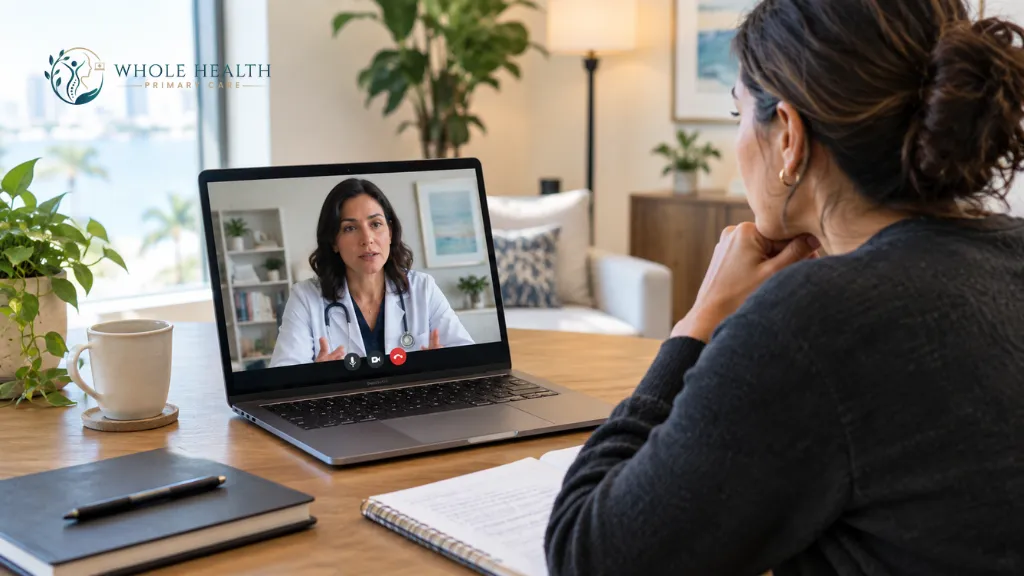
Most people hear “virtual primary care” and picture video calls for colds and refills, with a real doctor’s office somewhere in the background handling everything that actually matters. That is not how this model works, and honestly, the gap between what people expect and what actually happens is usually where the hesitation comes from.
Think about the last time you needed a doctor for something that wasn’t urgent but wasn’t nothing either. Maybe your blood pressure numbers had been creeping up for months, or you’d been tired in a way that didn’t feel like normal tired anymore. Did that visit involve someone actually examining you with their hands, or mostly involve someone asking questions, looking at a screen, and typing? For a lot of primary care, it’s the second one, and that’s exactly the part a video visit can do just as well.
Here’s what a fully virtual primary care practice can and cannot do, and how the pieces that seem like they’d require an office actually get handled.
“Wait, is this a real primary care practice or just a nurse line?”
It’s a real, licensed primary care practice. The difference is where the visit happens, not what happens during it.
At Whole Health Primary Care, Dr. Octavia Garcia, DNP, FNP-C diagnoses conditions, orders labs, manages chronic disease, and prescribes medication, the same clinical work a primary care provider does in a physical office. Every visit runs 30 to 60 minutes on a HIPAA-compliant video platform instead of a waiting room, which, if you think about it, is longer than most in-person primary care appointments get anyway. A nurse line triages symptoms and tells you where to go next. This is a provider who actually manages your ongoing care, orders your labs, adjusts your medications, and remembers what you talked about three visits ago.
“What can actually get diagnosed and treated over video?”
More than most people expect, and less than absolutely everything. That’s the honest answer, not the marketing one.
A provider can take a full history, ask detailed follow-up questions, look at a rash or a visible symptom on camera, review medication lists, interpret lab results, and talk through a treatment plan in real depth because the visit isn’t capped at ten minutes. Chronic disease management for things like high blood pressure, diabetes, thyroid conditions, and high cholesterol works well this way since most of that care is tracking numbers, adjusting medication, and coaching on daily habits, none of which requires a hands-on exam. Say you’ve been managing borderline high blood pressure for two years. What actually happens at most of those follow-up visits? Someone checks your home readings, asks about salt intake and stress and whether you’re taking the medication consistently, maybe adjusts the dose. None of that needs an exam table.
Persistent symptom evaluation, meaning the fatigue, digestive issues, or vague complaints that never got a real answer somewhere else, also fits the virtual model well. That process is mostly detailed history taking and targeted lab work, not a physical exam finding the answer on the spot. If anything, the extra visit time helps here more than an in-person setting would, because these cases usually get missed the first few times specifically because nobody had enough time to ask the right follow-up questions.
What genuinely needs hands-on exam is a shorter list than people assume: certain abdominal complaints where palpation actually changes the diagnosis, a joint or musculoskeletal injury that needs to be physically assessed for range of motion and stability, anything requiring a procedure done in person like a biopsy or an injection. A good virtual provider tells you directly when something falls into that category and refers you out instead of trying to force it into a video visit it was never going to work for.
“How do labs even work if there’s no office to go to?”
The blood draw happens locally. The interpretation happens with your provider, which is honestly the part that matters more anyway.
Your provider orders the labs through the virtual platform, the same way any primary care provider orders labs, whether they’re sitting across from you or not. Those orders route to a lab facility near you for the actual draw, and once results come back, you review them together on your next visit instead of getting a portal message with a wall of numbers and zero context. The annual comprehensive panel covers a metabolic panel, CBC, lipids, thyroid function, A1c, vitamin levels, and hormone markers, and that review is a dedicated conversation, not a five minute afterthought tacked onto something else at the end of a rushed visit.
“Can they actually prescribe medication, or just talk about it?”
Yes. Real prescriptions, sent to your pharmacy the same day in most cases.
Prescription management through a virtual DPC model works close to how it does in a traditional office. Your provider reviews your history, discusses options, and sends the prescription electronically to whichever pharmacy is convenient for you, no paper script, no faxing, none of the old friction. The exceptions are a small category of controlled substances where federal telehealth prescribing rules are stricter, and those situations get handled case by case, usually with clear guidance on what the alternative process looks like rather than a dead end.
“What actually can’t be done through this model?”
A few specific things, and it’s worth naming them directly instead of glossing over it, because a practice that hides its limits is exactly the kind you shouldn’t trust.
No emergency care. Chest pain, stroke symptoms, severe injury, anything urgent goes to 911 or an emergency room, never a scheduled video visit. No in-person procedures like stitches, joint injections, or minor surgery. No physical exam findings that genuinely require touch, like checking for an enlarged organ or assessing a suspicious lump by palpation. Picture someone calling in with sudden, severe abdominal pain. That’s not a video visit conversation, that’s an ER visit, and a responsible virtual provider says so immediately instead of trying to talk someone through it on camera. A practice that’s upfront about this list is more trustworthy than one that implies video can replace all of it, because it can’t, and pretending otherwise is how people end up with delayed care for something that needed a different setting entirely.
“What does a first visit actually look like?”
Longer and more thorough than what “first appointment” usually means at a traditional practice, mostly because nobody’s trying to fit it into a fifteen minute slot.
It starts with a comprehensive intake before the clinical visit even happens, a full review of your health history and any previous records, and a dedicated care planning session where your provider actually walks through what she’s seeing and what the plan looks like going forward. Compare that to the average new patient visit at a typical practice, where you fill out a clipboard in the waiting room and get maybe twelve minutes with an actual provider before you’re back in your car. The intake process here is built to front load the understanding so the ongoing visits are efficient instead of repetitive.
“I’ve never done a video doctor visit before, is it going to feel awkward or rushed?”
Less awkward than you’d think, and less rushed than almost any in-person visit you’ve probably had recently.
The platform itself works about the way any video call does, nothing complicated, nothing that requires tech skills beyond what most people already use daily. What tends to surprise people is the pacing. There’s no one in a waiting room after you, no medical assistant popping in to say the provider’s running behind, no sense that you need to get to your questions fast before time runs out. If you’ve spent the last ten years of doctor visits feeling like you had to talk fast and prioritize which symptom to mention first, this is a genuinely different rhythm, and it takes maybe one visit to stop bracing for the rush that never comes.
“How is this different from a one-off telehealth app or urgent care video visit?”
Continuity, mostly. That’s the whole difference, and it’s a bigger difference than it sounds.
A one-off telehealth visit through an urgent care app connects you with whichever provider is available that day, someone who’s never seen your chart before and won’t see you again after this. It’s built for a single acute problem, a sinus infection, a UTI, something with a clear beginning and end. Virtual primary care is the opposite structure. Same provider every time, someone who has your full history, knows what’s already been tried, and is managing your health as an ongoing relationship rather than a transaction. If you’ve ever explained your entire medical history to a new provider for the third time in a year because you kept getting routed to whoever was on call, this is the model built specifically to prevent that.
“Does this cover preventative care, like an annual physical, or just sick visits?”
Preventative care is actually a core part of the model, not an add on.
Preventative care and wellness screening covers the annual comprehensive evaluation, risk screening based on your history and age, and the kind of proactive conversation about diet, sleep, stress, and movement that often gets skipped entirely in a rushed ten minute annual physical. Combined with lifestyle medicine, which looks at the daily habits actually driving most chronic disease risk, the preventative side of this model tends to get more attention here than it does in a lot of traditional practices, partly because there’s simply time on the calendar for it.
“Isn’t a 30 to 60 minute video visit kind of excessive for primary care?”
It’s actually the opposite of what most people are used to, and that’s the whole point.
A standard in-person primary care visit with insurance involved often runs closer to 10 to 15 minutes once you subtract the waiting room, the intake paperwork, and a provider managing a packed schedule built around insurance reimbursement math. A membership model without insurance billing removes the incentive to rush, which is why the visit length here is closer to what a real conversation about your health actually needs. Time spent is often the difference between “here’s a prescription, next patient” and a provider who actually understands what’s been going on for months.
“What happens if something comes up that really does need an in-person visit?”
You get told plainly, and referred somewhere appropriate. No stalling, no trying to manage it remotely because it’s inconvenient to say otherwise.
Part of what makes a virtual primary care model actually work is a provider who recognizes the edge of what video can responsibly handle and says so. That might mean a referral to a specialist, an urgent care visit for something that needs same day hands on evaluation, or the ER for anything emergent. Whole person, trauma informed care doesn’t mean avoiding in-person care when it’s genuinely needed. It means the visits that make up most of primary care get handled well, and the exceptions get handled honestly instead of awkwardly stretched to fit a format they don’t belong in.
“Does not taking insurance make this more expensive overall?”
Usually less, once you count what a flat fee actually replaces, though it’s fair to be skeptical of that claim until you run the numbers yourself.
Since this runs on a direct primary care membership rather than insurance billing, there’s no per visit copay, no surprise bill for a longer appointment, and no incentive to see you for the minimum time insurance reimbursement allows. The membership includes a one time enrollment fee covering the comprehensive intake and care planning session, then a flat monthly fee from there covering the visits, the ongoing relationship with the same provider, and the coordination between them. For someone managing an ongoing condition who’d otherwise need frequent visits stacked with copays, urgent care fees for the gaps, and specialist referrals with their own billing, that structure tends to cost less over a full year, not more. It’s worth actually comparing what a year of your current care costs against a flat monthly number before assuming insurance-based care is automatically the cheaper option, because for a lot of people managing something chronic, it isn’t.
What to expect if you’re considering it
Membership starts with the comprehensive intake, a full records review, and a care planning session before the ongoing visits begin, all covered under the initial enrollment. From there, scheduling a visit typically means same day or next day access rather than the multi week wait common with traditional practices, and every visit happens on the same HIPAA-compliant platform from wherever you are in Arizona or Texas. If a question about whether your specific situation fits the model is holding you back, that’s a reasonable thing to ask directly before enrolling rather than guessing.
This article is intended for general informational purposes only and does not constitute medical advice. Whether virtual primary care is appropriate for a specific situation depends on individual health history and current symptoms. If you are experiencing a medical emergency, call 911 or go to the nearest emergency room.
FAQs
Is virtual primary care a real medical practice or just a nurse hotline?
A real, licensed practice. At Whole Health Primary Care, a doctorally trained nurse practitioner diagnoses, orders labs, manages chronic conditions, and prescribes medication, the same clinical scope as an in-person primary care provider, with the continuity a one-off nurse line doesn’t offer.
What conditions can be treated through video visits?
Chronic disease management (blood pressure, diabetes, thyroid, cholesterol), persistent symptom evaluation, preventative care, and most day-to-day primary care needs. Anything requiring hands-on exam or a procedure gets referred out.
How do lab tests work without a physical office?
Your provider orders labs through the platform, you get the blood draw done at a facility near you, and results get reviewed together on a follow-up video visit instead of a portal message with no context.
Can a virtual provider actually prescribe medication?
Yes, sent electronically to your pharmacy the same day in most cases. A small category of controlled substances has stricter federal telehealth rules and gets handled case by case.
What can't be done virtually?
Emergency care, in-person procedures, and physical exam findings that require actual touch. Those get referred to the ER, urgent care, or a specialist as appropriate, and a trustworthy provider says so upfront.
How is this different from a one-off telehealth or urgent care video app?
Continuity. A one-off visit connects you with whoever’s available for a single acute issue. Virtual primary care means the same provider managing your full history over time.
Does it cover annual physicals and preventative care?
Yes, that’s a core part of the model, including risk screening and lifestyle-focused conversations that often get skipped in a rushed in-person physical.
Why are the visits 30 to 60 minutes long?
Because there’s no insurance billing dictating visit length. That time is usually what separates a provider who understands what’s actually going on from one working through a packed schedule.
Is it more expensive than insurance-based care since it's not covered?
Usually less over a year for people managing ongoing conditions, once you count copays, urgent care gaps, and specialist billing against a flat monthly fee.