
About 38 million Americans live with diabetes. Nearly half of all adults in the country have high blood pressure. Those two conditions make up a huge share of what a primary care doctor spends their time managing, and they’re also the two conditions people assume, almost automatically, need an in person office visit to handle properly. That assumption doesn’t really hold up anymore. Diabetes and blood pressure both get tracked through numbers, blood sugar readings, A1C results, and blood pressure readings, and a patient can gather those numbers at home just as accurately as in a clinic. That’s the whole reason virtual primary care has turned into a legitimate, research backed way to manage both conditions over the long run.
“What does managing diabetes through virtual care actually look like day to day?”
Pretty close to the same routine as in person care, minus the drive to an office every time something needs a look.
A1C testing still happens the way it always has. It’s a blood test that shows average blood sugar over the past two or three months, ordered through laboratory testing, though the actual blood draw usually happens at a local lab near home instead of inside a clinic. In between those lab checks, day to day blood sugar tracking runs through a home glucometer or a continuous glucose monitor. Those readings get reviewed remotely, and medication gets adjusted off the pattern the numbers show over time rather than off a single moment in an exam room. Chronic disease management is built around that kind of ongoing adjustment specifically, instead of a once a year checkup that misses months of ups and downs in between.
A lot of the real work happens in medication management. Diabetes medication needs fine tuning more often than people expect. A dose that worked fine three months ago can suddenly need adjusting once diet, activity, weight, or stress shifts. Prescription management through virtual care lets that adjustment happen off a home glucose log and a phone or video conversation, instead of waiting weeks for the next open office slot while blood sugar sits out of range the whole time.
“Can blood pressure really be tracked accurately without a clinical setting?”
Yes, and there’s actually a decent argument that home monitoring beats the office reading most people are used to.
Office blood pressure readings run into something called white coat syndrome pretty often, where the stress of sitting in a medical setting temporarily pushes the number above someone’s real baseline. Home monitoring, done consistently with a validated cuff, tends to paint a more accurate picture of someone’s actual blood pressure over time, mostly because it catches numbers across different times of day and different situations instead of one stressful snapshot taken in an exam room. A week of home readings, logged twice a day, hands a provider a far more useful data set than one number taken during a rushed fifteen minute visit.
That data still needs a clinical eye on it somewhere, and that’s really where virtual primary care earns its place. Spikes at certain times of day, a slow upward drift over weeks, readings that just aren’t responding the way they should to the current medication, all of that gets reviewed and acted on the same way it would in an office. The only real difference is that it’s working off a shared log instead of an in office cuff.
“Is virtual care actually as effective as in person visits for these conditions, or is that just marketing?”
The research actually backs it up, not just as adequate, but as genuinely effective.
Several studies on telehealth based chronic disease management found that patients managing diabetes remotely, with regular check ins and remote monitoring built in, ended up with A1C improvements on par with people managed in person, and a few studies even found slightly better results. Researchers point to more frequent touchpoints as the likely reason, since remote care tends to check in far more often than the typical quarterly in office schedule allows. Blood pressure shows the same pattern. Remote monitoring programs that pair home readings with regular provider review have shown real, measurable improvements in blood pressure control next to standard care built around infrequent office visits. None of this is especially mysterious once you sit with it. Checking in more often, with less friction involved each time, catches problems and needed adjustments faster than a system built around occasional in person visits, where months can slip by between any meaningful data point.
“What does a typical month actually look like for someone managing both conditions this way?”
Fairly structured, honestly, once the routine settles in, which usually takes a few weeks.
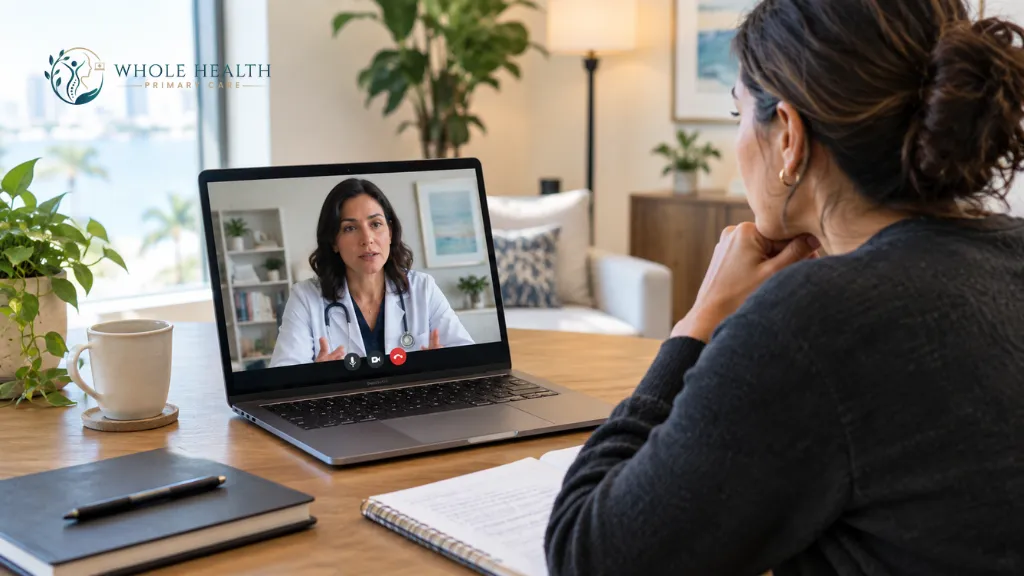
Picture someone managing type 2 diabetes and high blood pressure at the same time, which happens more often than people realize, since the two conditions share enough risk factors that having one raises the odds of the other. Mornings start with a quick blood pressure reading and, depending on their diabetes management plan, a fasting glucose check, both logged into an app or a simple notebook. Those numbers get reviewed on a set cadence, maybe every two weeks at first while a new medication or dose gets dialed in, then monthly once things stabilize. A short video call covers what the numbers showed, whether anything needs adjusting, and whatever’s come up day to day, a new symptom, a stretch of stress at work, a change in appetite. Lab work happens every few months rather than every visit, since A1C in particular only moves meaningfully over a longer stretch of time. None of this is more complicated than in person care. It’s mostly the same rhythm, just without the parking, the waiting room, and the half day taken off work for a fifteen minute appointment.
“Do I need special equipment at home to make this work?”
Not much, and most of it is inexpensive and easy to find.
A validated blood pressure cuff is the main piece of equipment for hypertension management, and the word validated actually matters here. Not every cuff sold online has been checked against clinical standards for accuracy, so getting guidance on which one to buy is worth asking about early rather than guessing. For diabetes, a standard glucometer with test strips covers most day to day monitoring needs, while a continuous glucose monitor, a small sensor worn on the skin that tracks blood sugar automatically throughout the day, gives a much fuller picture for anyone whose blood sugar swings significantly or who’s on insulin. Neither piece of equipment requires special training beyond a quick walkthrough, and most people get comfortable with the routine within the first week or two.
“How is this different from just using a random telehealth app when something comes up?”
The difference comes down to relationship versus transaction, and that distinction actually matters a lot for chronic conditions specifically.
A one off telehealth visit, the kind built for a sinus infection or a rash, connects someone with whichever provider happens to be available that day, who has no history with that patient and won’t be the one following up next time either. Diabetes and blood pressure don’t really work that way. Both conditions need a provider who knows the trend line, not just the single reading in front of them right now, someone who remembers that a medication got adjusted six weeks ago and can tell whether the current numbers reflect that change working or not working. That continuity is exactly what gets lost with app based, on demand telehealth, and it’s exactly what an ongoing virtual primary care relationship is built to preserve.
“What actually requires an in person visit, then? Nothing?”
Some things genuinely do, and a good virtual primary care practice says so upfront instead of pretending everything can be handled through a screen.
Some initial diagnostic workups need a physical exam or a procedure that video just can’t replicate. Certain complications from long standing diabetes need hands on, in person evaluation too, diabetic foot issues in particular, along with vision changes tied to diabetic retinopathy. A severe, acute spike in blood pressure that looks like a hypertensive emergency needs immediate in person or emergency care, full stop, not a scheduled virtual visit. Persistent symptom evaluation is where that call actually gets made, sorting out what fits inside the ongoing virtual relationship and what needs a referral or an in person look right away.
“How does lifestyle change factor into this if the doctor isn’t seeing me in person?”
It’s actually one of the places virtual care tends to shine, since most lifestyle coaching was never something that needed an exam room in the first place.
Diet, activity, sleep, and stress all move the needle on both blood sugar and blood pressure, and working on those factors often matters just as much as medication for keeping either condition under control. Lifestyle medicine takes that on directly, working through changes that actually fit someone’s real life instead of handing over a generic printout, and that conversation tends to go better on a video call from someone’s own kitchen than it does in a clinical office that has nothing to do with how they actually live day to day. Walking through a week of meals, activity, and sleep together on a call usually produces more specific, usable advice than the rushed five minutes it gets tacked onto the end of a typical in office visit.
“What about preventing these conditions in the first place, or catching them early?”
That’s arguably where regular primary care does the most good, virtual or not, since diabetes and high blood pressure both tend to build quietly for years before any symptom shows up.
Preventative care and wellness screening catches prediabetes and early stage high blood pressure before either one turns into a diagnosis that needs daily medication, through routine bloodwork and blood pressure checks folded into regular visits instead of waiting for something to become obviously wrong. Anyone with a family history of either condition, or early warning signs like blood pressure readings that keep landing right on the border, benefits from that kind of steady tracking well before anything crosses into diagnosis territory. Catching prediabetes early opens up real options, lifestyle changes that can prevent or significantly push back a full diabetes diagnosis, and that window closes fast once blood sugar has been running high for years.
What This Looks Like at Whole Health Primary Care
Managing diabetes or high blood pressure at Whole Health Primary Care means regular virtual visits, home monitoring reviewed consistently, and laboratory testing through local labs, all working as one plan instead of separate pieces. Chronic disease management and prescription management run together so medication gets adjusted off real, current data instead of whatever the numbers happened to be months ago, and our providers work with each patient directly to figure out a monitoring routine that actually fits their life. Getting started just means scheduling a visit to go over where things stand right now and build a plan from there.
Medical Disclaimer: This article is for general informational and educational purposes only and is not a substitute for professional medical advice, diagnosis, or treatment. Always consult a qualified healthcare professional for advice about your individual health needs.
FAQs
Can diabetes actually be managed without in person visits?
Is home blood pressure monitoring accurate enough to rely on?
Does research actually support virtual chronic disease management, or is it just convenient?
What still requires an in person visit?
Can virtual care help prevent these conditions, not just manage them?


[…] just opens a window where treatment options are genuinely broader than they’ll be later, and managing a chronic condition like diabetes or high blood pressure once it’s already establish… looks noticeably different from catching either one at the early, still reversible […]
[…] Managing diabetes or high blood pressure through virtual primary care covers how lifestyle focused management works alongside medication for conditions that are already more advanced, where lifestyle changes support and sometimes reduce medication needs over time rather than replacing treatment outright. For conditions that are more established, lifestyle medicine still matters considerably, just as one part of a broader approach rather than the entire plan. […]
[…] Managing diabetes or high blood pressure through virtual primary care covers this in more depth, specifically for the kinds of chronic conditions where prescription adjustments happen often enough that convenience actually affects whether they happen on time. […]
Comments are closed.